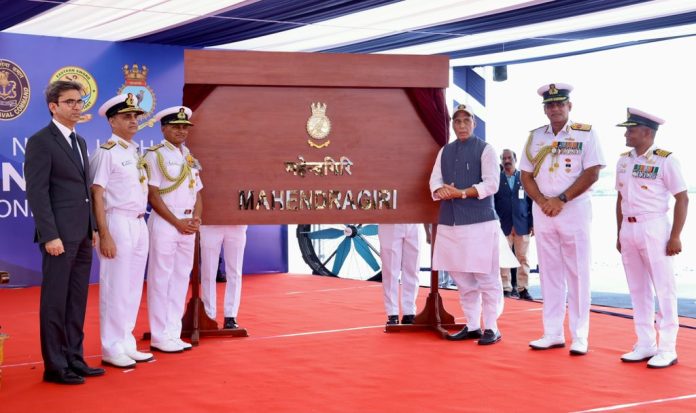
The Indian Navy today inducted the indigenously-built advanced stealth frigate ‘INS Mahendragiri’ into its Eastern Fleet in a ceremony presided over by Raksha Mantri Mr Rajnath Singh at Visakhapatnam aka Vizag.
Named after the Mahendragiri mountain range in the Eastern Ghats, INS Mahendragiri symbolises strength, steadfastness and indomitable resolve, and bears the motto ‘Mighty, Majestic, Matchless’.
Built through the contribution of more than 200 Indian industries, including numerous MSMEs, the ship reflects India’s growing defence manufacturing capability.
The frigate features advanced stealth characteristics, a Combined Diesel or Gas propulsion system, an Integrated Platform Management System and advanced indigenous combat systems.
In his address Raksha Mantri described this frontline warship as a reflection of India’s growing self-reliance in shipbuilding, underpinned by exceptional design capabilities, manufacturing excellence, the rapid growth of the naval-industrial ecosystem, and its ability to deliver state-of-the-art platforms in a timely manner.
About the Warship
‘INS Mahendragiri’ is the sixth Project 17A indigenous stealth frigate to be inducted into the Indian Navy in a span of just 1.5 years.
The first ship of the series ‘INS Nilgiri’ was commissioned in January 2025, followed by ‘INS Udaygiri’ & ‘INS Himgiri’ in August, ‘INS Taragiri’ in April this year and ‘INS Dunagiri’ last month.
Designed by the Indian Navy’s Warship Design Bureau and built by Mazagon Dock Shipbuilders Limited (MDL), Mumbai, the ship is capable of undertaking the full spectrum of maritime operations, including fleet air defence, anti-surface warfare, anti-submarine warfare, maritime interdiction, surveillance and humanitarian assistance & disaster relief (HADR).
The warship, with over 75 percent indigenous content, has a displacement of approximately 6,670 tonnes and the capability to reach speeds of up to 28 knots.
It is equipped with supersonic surface-to-surface missiles, medium-range surface-to-air missiles, anti-submarine warfare capabilities and an embarked multi-role helicopter, as well as advanced stealth features, modern sensors, network-centric combat systems and state-of-the-art weapon suites.
“INS Mahendragiri can be equipped with the BrahMos surface-to-surface missile, one of the world’s fastest and most lethal cruise missiles.
It also features a combination of multifunction radar and Surface-to-Air Missiles capable of detecting and neutralising aerial threats at extended ranges.
Its arsenal also includes an indigenous rocket launcher, torpedo launchers, an Integrated Anti-Submarine Defence System, an Electronic Warfare suite and a Close-In Weapon System.
All these capabilities make the warship formidable and resilient,” said India’s defence minister, exuding confidence that the “blue-water ship” will safeguard India’s maritime interests not just near the coast but far out in the deep oceans as well.
Nature of Emerging Warfare
Raksha Mantri emphasised that while emerging technologies such as drones, artificial intelligence, cyber warfare, space-based capabilities, hypersonic weapons and unmanned systems have significantly transformed the nature of warfare, conventional military capabilities continue to form the bedrock of effective defence.
“Future wars may be fought with Artificial Intelligence, but they will still be won by national resolve, trained soldiers and credible military power,” he said while stressing that advanced technologies and conventional platforms complement one another rather than act as competitors.
Indo-Pacific Region
Highlighting the strategic importance of the Indo-Pacific region, he reaffirmed the Government’s commitment to the vision of Security and Growth for All in the Region (SAGAR).
“India is a net security provider and a trusted partner dedicated to ensuring security and development across the region,” said Mr Singh, while praising the Indian Navy for consistently demonstrating this commitment through its role in HADR operations, anti-piracy missions and the evacuation of Indian and foreign nationals from crisis-hit areas.
The Indian Navy has earned the recognition as both a First Responder and a Preferred Security Partner in the Indo-Pacific through its timely & effective operational response, he added.
Chief of Naval Staff
Admiral Krishna Swaminathan, Chief of the Naval Staff termed INS Mahendragiri as a symbol of India’s growing maritime capability and technological self-reliance.
He stated that the commissioning of the sixth Project 17A frigate marks another milestone in indigenous warship construction, significantly enhancing the Indian Navy’s operational capability.
The CNS reaffirmed that the Indian Navy remains a combat-ready, credible, cohesive and future-ready force.
The ceremony included the traditional breaking of the Commissioning Pennant and maiden hoisting of the National Flag onboard.
Flag Officer Commanding-in-Chief, Eastern Naval Command Vice Admiral Sanjay Bhalla, CMD, MDL Captain Jagmohan (Retd), senior naval officers, veterans, representatives of the shipbuilding industry and other invited guests were present on the occasion.
Upon joining the Eastern Fleet, the Indian Navy’s Sunrise Fleet, INS Mahendragiri will significantly enhance India’s maritime combat capability and operational reach in the Indian Ocean Region, reinforcing India’s commitment to a future-ready Navy under the vision of MAHASAGAR.