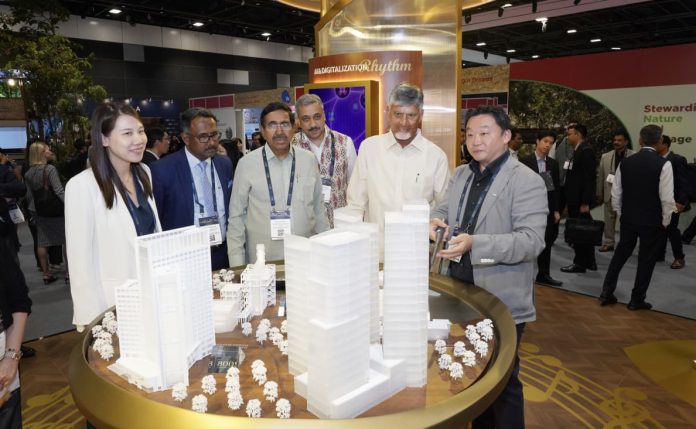
Chief minister Mr N Chandrababu Naidu led a high-level delegation to Singapore aimed at studying practical models that can support Andhra Pradesh’s ongoing urban transformation.
The visit as per the Municipal Administration and urban development was particularly in the context of Amaravati capital city development, regional urban planning, sustainable infrastructure, municipal service delivery and waste-to-energy initiatives.
The visiting delegation comprised of MA&UD minister Mr Ponguru Narayana, Principal Secretary to Government, MA&UD Department, Mr S. Suresh Kumar, IAS and Mr Praveenchand, IAS, Additional Commissioner, APCRDA.
As part of the visit the delegation held a series of focused engagements with leading Singapore-based institutions, including NUS Cities of the National University of Singapore, Surbana Jurong Innovation Hub in the Jurong Innovation District, and the Tuas South Incineration Plant operated under Singapore’s integrated waste management framework.
Urban Planning
At NUS Cities, the delegation explored possibilities for a knowledge partnership in the areas of urban planning, urban design, urban systems, climate resilience, governance, capacity building and data-driven city management.
NUS Cities, as a platform of the National University of Singapore, brings together expertise across urban planning, architecture, engineering, climate science, data science, economics and governance.
Discussions focused on how such multidisciplinary expertise can be leveraged for Amaravati, which is one of the few large-scale greenfield capital city projects in the world.
The engagement with NUS Cities assumes significance as Andhra Pradesh is seeking to build Amaravati not merely as an administrative capital, but as a future-ready, climate-resilient, knowledge-driven and globally competitive city said the release from MAUD.
The proposed collaboration is expected to help bring international academic depth, research-based planning support and executive capacity building to APCRDA, MA&UD Department, urban local bodies, planners and engineers involved in the State’s urban development agenda.
Innovation Hub
Similarly, the delegation visited the Surbana Jurong Innovation Hub located in the Jurong Innovation District.
The visit focused on understanding Singapore’s approach to integrating land-use planning with economic development, sustainability, smart infrastructure and innovation-led urban growth.
Surbana Jurong’s campus has been developed as a “living lab” to demonstrate how emerging technologies can be tested, monitored and scaled for the built environment sector.
The Surbana Jurong model provided important insights into the design of sustainable and people-centric workplaces, intelligent building systems, energy-efficient infrastructure, green building practices, smart monitoring systems and long-term maintainability of public infrastructure.
Solid Waste Management
As part of the study of scientific municipal solid waste management, the delegation visited the Tuas South Incineration Plant and held discussions with Dr Benjamin Koh, Interim Chief Executive Officer of Singapore’s National Environment Agency, along with members of the NEA Board and senior officials.
The visit focused on Singapore’s integrated approach to waste collection, incineration, waste-to-energy conversion, ash management, scrap recovery, environmental safeguards and plant-level operational efficiency.
AP’s Minister for Municipal Administration & Urban Development Mr Narayana stated that the Government of Andhra Pradesh is committed to building clean, green, sustainable and economically productive cities.
He added that under the leadership of Chief Minister Naidu, the State is pursuing a clear vision to develop Amaravati and other cities with world-class standards, while ensuring that urban development remains people-centric, environmentally responsible and economically meaningful.
The Minister observed that Singapore’s experience demonstrates the importance of integrated planning, disciplined execution, institutional coordination and long-term urban governance.
It was further informed that MA&UD would carefully examine the learnings from the visit and adapt suitable models to the requirements of Andhra Pradesh, particularly in areas such as Amaravati capital city development, planned urban expansion, sustainable infrastructure, solid waste management and waste-to-energy.
Principal Secretary to Government, MA&UD Department, Mr Kumar, IAS, stated that the visit has provided highly relevant and actionable insights for Andhra Pradesh’s urban development priorities.
The Amaravati Opportunity
He stated that Amaravati provides a unique opportunity to apply global best practices from the beginning and to build a capital city that integrates land use, mobility, environment, water systems, economic development, digital governance and citizen services in a comprehensive manner.
Mr Suresh Kumar noted that partnerships with reputed institutions can help the State strengthen planning quality, improve project preparation, build technical capacity and introduce innovative tools such as urban observatories, climate resilience frameworks, digital twins and data-driven decision-making systems.
The principal secretary said the Department will identify specific areas where the learnings can be translated into policy actions, pilot projects, technical collaborations and capacity-building programmes.
The MA&UD Department will undertake further consultations to identify appropriate collaboration models and implementation pathways.
The exposure to Singapore’s globally recognised urban systems is expected to support the State in refining its planning frameworks, improving institutional capacity and accelerating implementation of high-quality urban projects.