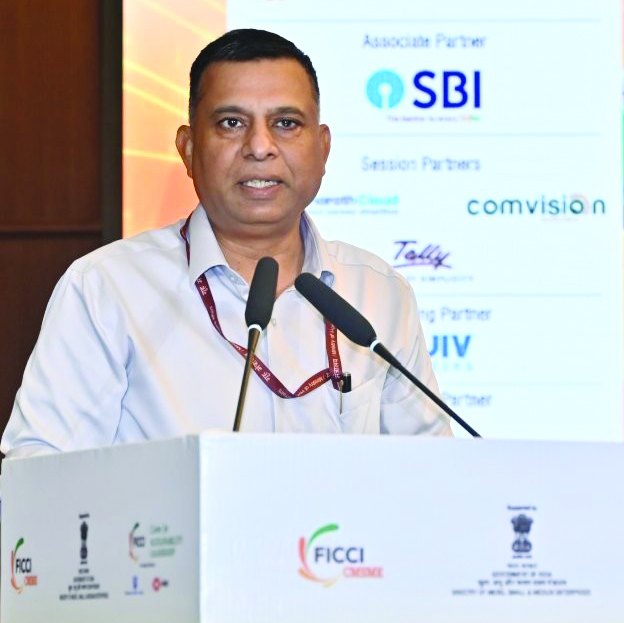
Identifying MSMEs to be the true engines of India’s inclusive growth and employment generation, Dr Rajneesh, Additional Secretary and Development Commissioner (MSME), Ministry of Micro, Small and Medium Enterprises, Government of India, noted that India today has over 6.9 crore registered MSMEs on the Udyam portal, providing employment to nearly 30 crore people.
“Our goal is to add another 4 crore MSMEs to this ecosystem in the next four to five years,” he said addressing the 11th Edition of the FICCI CMSME Summit 2025 on the theme ‘Future Ready MSMEs: Digital, Green, and Inclusive’.
Elaborating on government interventions, Dr Rajneesh shared that the Ministry of MSME is focusing on institutional mechanisms that unlock the sector’s full potential. “Through the Credit Guarantee Trust for Micro and Small Enterprises (CGTMSE), we have enabled over Rs 8 trillion in additional credit over the last three years—more than double the amount achieved in the previous two decades,” he informed.
He emphasized that the perception of MSMEs as high-risk borrowers is a ‘myth’ and cited RBI data showing an NPA rate of only 3.5% for MSMEs. “Access to affordable finance is the key to unlocking entrepreneurship, innovation, and sustainable growth among MSMEs,” he asserted.
Dr Rajneesh underlined that the focus on technology, sustainability, competitiveness, and access to finance is critical to make MSMEs future ready.
“MSMEs are spread across Tier 2, 3, 4, and 5 towns and have become the backbone of India’s resilient and geographically inclusive growth story,” he added.
Dr. Rajneesh also underscored the Ministry’s recent efforts to promote sustainability and technology-driven competitiveness through schemes like GIFT and SPICE, which incentivize MSMEs to adopt greener and more efficient manufacturing practices.
Highlighting the government’s ongoing collaboration with states under the RAMP Programme, Dr. Rajneesh said, “We are working with state governments to design area-specific strategic interventions for MSMEs—because their challenges in the Northeast, coastal regions, and hinterlands are not the same. Future readiness requires solutions that are local, adaptive, and innovation led.